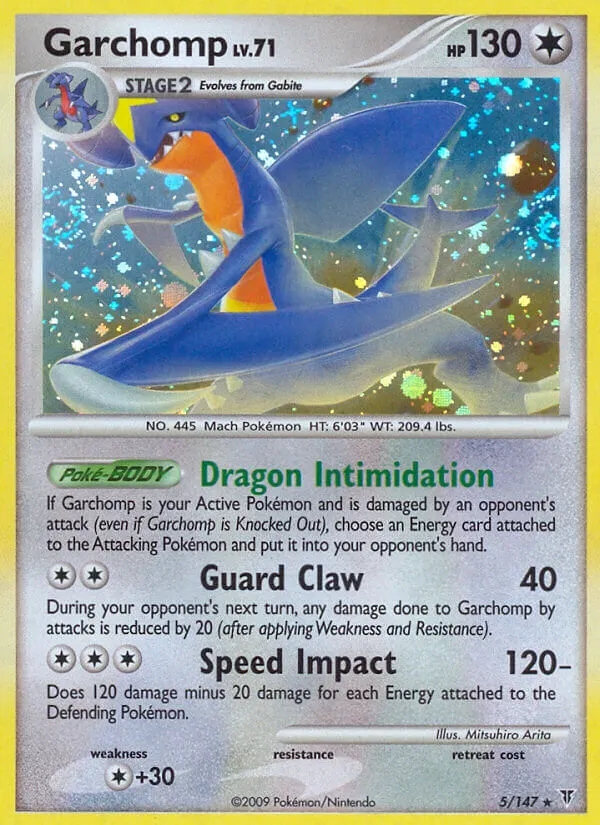
Garchomp SV is, in my opinion, one of the most criminally underrated cards in Pokemon’s storied history. It sports a rather annoying Poke-Body, backed up by an equally annoying Guard Claw attack, making KOs on the land shark a real nuisance to achieve. Speed Impact rounds out its attacks, threatening large damage in a format where many of the top threats (Gyarados, Jumpluff, anything using Energy Gain) don’t attach very many energy. And if that wasn’t enough, it has free retreat to cycle to the bench as well!
Why wasn’t it played more? 2010 had no rotation to begin the season, so SP decks were already very developed. The SP Engine revolving around Cyrus’s Conspiracy had been optimized far beyond most stage 2 decks in this timeframe, since people had already been using that engine for many months. Weakness to Colorless certainly didn’t help either – one of the most popular attackers in SP decks is Garchomp C Lv. X – a pokemon which, in combination with Lucario GL, threatens a clean one-hit KO. As a result, Garchomp SV wasn’t explored as much as it probably should have been, but it’s still one of the strongest (and one of the most fun!) archetypes from this format.
Contents
- Tournament Placings & Notable Decklists
- Skeleton Decklist
- What the tech?
- Considerations for DP Block
- Conclusion
Tournament Placings and Notable Decklists

Photo Source: Ben Robinson & PTCG Archive
Decklist: Mark Garcia, Top 8 US National Championships
This is probably the most well-known version of this deck I’ve seen float around – Mark Garcia brought this to US Nationals and surprised the field with a top 8 finish. It can abuse Double Colorless Energy and Broken Time-Space to get Garchomp set up as early as turn 2, and with Expert Belt and Crobat G, Speed Impact will even threaten KOs on pokemon with early energy attachments. Dusknoir is a neat tech here, keeping the opponent on the back foot. While Flygon wasn’t as popular in this event, it is noteworthy that Flygon RR with 3 bench Pokemon is exactly 10 short of a KO on Garchomp, so theoretically if your opponent wants to OHKO your Garchomp, they have to open themselves up to getting hit by Dusknoir. This deck also plays Cyclone Energy, Warp Point, AND Pokemon Reversal, giving you plenty of options to hit the opponent’s benched pokemon, which might not be as prepared to take a Speed Impact.
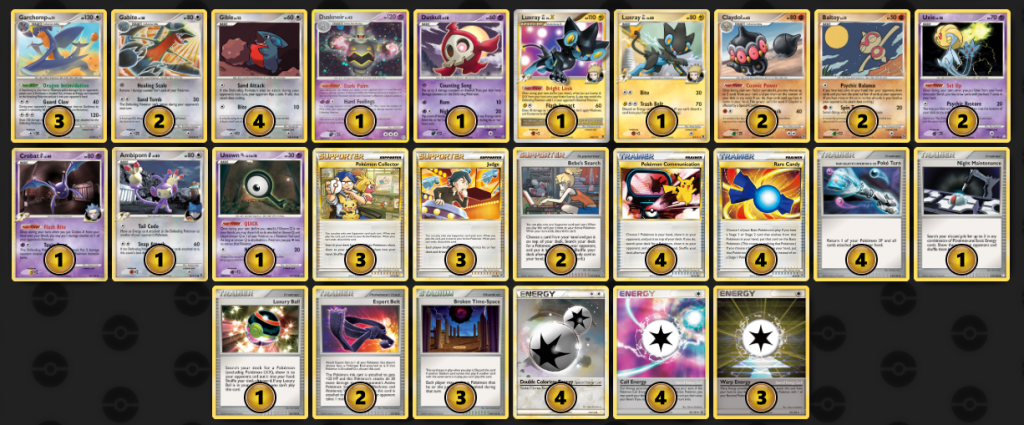
Photo Source: Alex Wilson & PTCGLegends
Decklist: Drew Guritzky, Top 32 World Championships
While this build functions somewhat similar to the last one, it does have a couple of different inclusions – Drew Guritzky opted for Luxray GL Lv. X instead of Cyclone, Warp, and Reversal. This way, you can consistently pick and choose which pokemon gets brought up to the active spot. Drew also included 3 copies of Warp Energy, which undoubtedly would have been helpful against decks trying to utilize Blaziken FB or Chatot MD to try and trap Dusknoir or Claydol in the active spot. Ambipom G is also a really cool inclusion by Drew as a tech against Garchomp C Lv. X (I’ll expand on this a bit in the next section).

Decklist: Jay Hornung, The Lost Zone
This is a different take on what Garchomp SV can do. Jay Hornung came up with this variation many years later, relying instead on Garchomp’s ability to tank hits with Guard Claw as opposed to taking quick KOs with Speed Impact. Guard Claw and Expert Belt already turns Garchomp into an extremely beefy attacker, but adding Nidoqueen to the mix gives you the option to retreat (for free) and promote a new Garchomp to take some hits while your old one gets healed. While going the tank route, Jay doesn’t rely as heavily on forcing the opponent’s bench to the active – you do still have a few ways to force a switch in Cyclone Energy and 1 copy of Warp Point, but it isn’t as central to the strategy as it looks with the other 2 decklists.
Skeleton Decklist
| Pokemon (14) | Trainers (16) | Energy (8) |
|---|---|---|
| 3 Garchomp 2 Gabite 4 Gible 2 Claydol 2 Baltoy 1 Uxie | 2 Roseanne’s Research/Pokemon Collector 2 Bebe’s Search 2 Judge 1 Palmer’s Contribution/Night Maintenance 4 Rare Candy 2 Pokemon Communication 1 Luxury Ball 2 Expert Belt | 4 Double Colorless Energy 4 Call Energy |
Fewer cards than most skeleton lists I’ve posted in this article series – a lot of the filler cards will depend on whether you want to play a more aggressive, Speed Impact-centered version, or a slower version centered around tanking with Guard Claw. Let’s take a look at some of the techs you might include in these decks:
What the Tech?
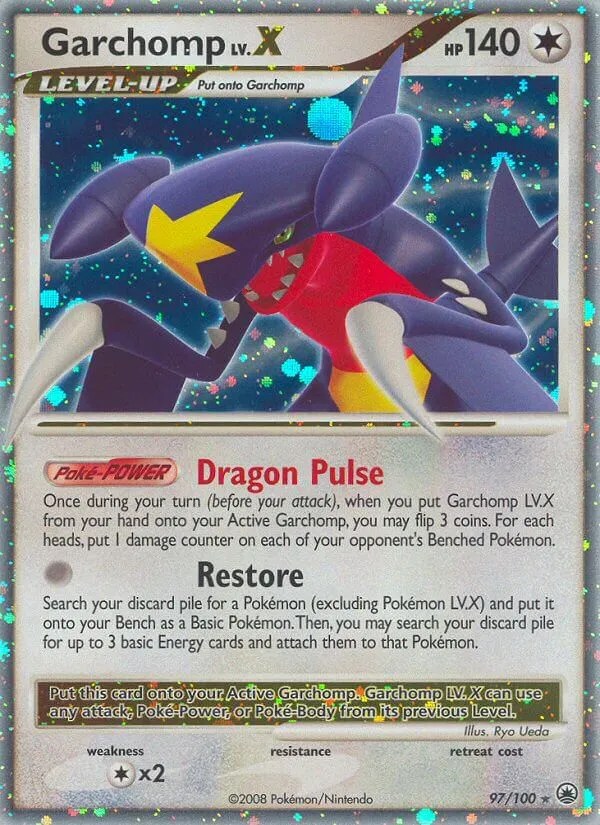
Let’s start at the root of the deck – the Garchomp line itself. Mark Garcia chose to include one copy of the Lv. X in his deck for US Nationals. In an aggressive version like this, I think playing the Garchomp Lv. X makes a lot of sense – the poke-power racks up damage on the opponent’s bench, and when you combine this with other damage modifiers like Expert Belt or Crobat G, it becomes very hard for anything to survive a Speed Impact.
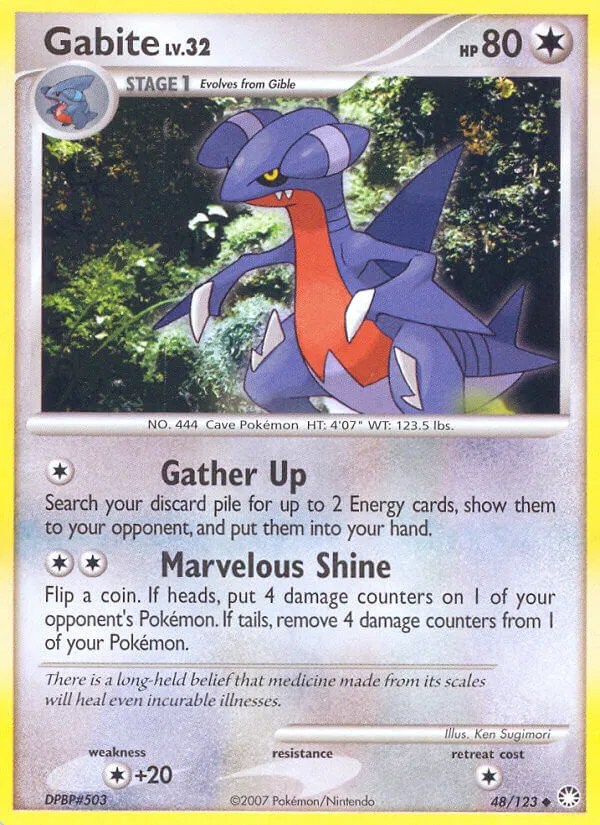

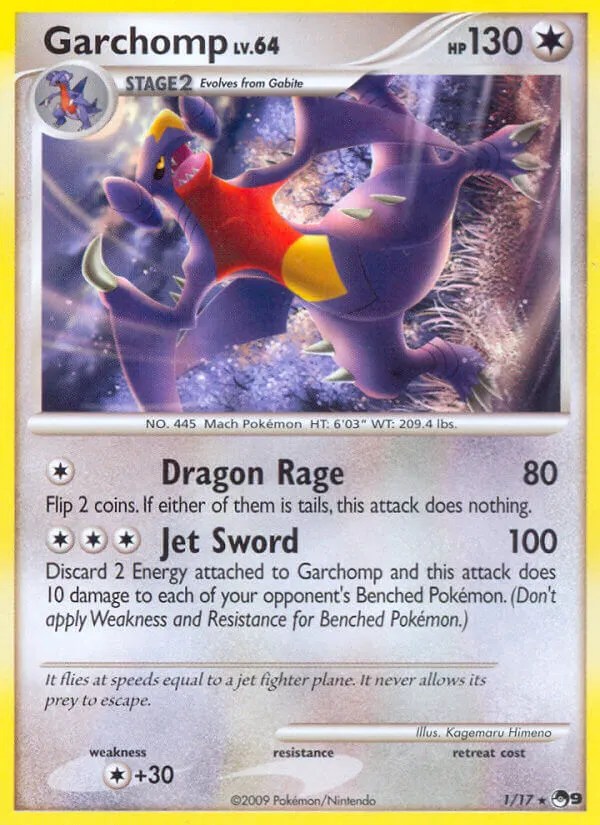
For the rest of the Garchomp line, there are a few options. Most decklists just use the Supreme Victors Gabite, as Healing Scale has applications against decks that try to spread damage around, while Sand Tomb gives you an option to potentially trap something active while you set up your bench. (It can also act as a pseudo-Chatter Lock against pokemon like Spiritomb if your opponent has a Nidoqueen RR in play). I did want to highlight Gabite MT, however, as Gather Up is a pretty neat attack in some scenarios – if your game drags on, or you are playing against a more controlling archetype, Gather Up does NOT specify that it has to be basic energy – the ability to grab back Special Energy is pretty rare across the Pokemon TCG, but this is one of the few cards that can do it. POP 9 Garchomp is also pretty unpopular, but Jet Sword is a beast of an attack – being able to discard a Double Colorless Energy for a clean 100 PLUS bench damage is pretty nice. If your opponent is playing an archetype that gets a lot of energy into play (like Flygon/Torterra, for example), Speed Impact and Guard Claw don’t actually do very much damage, so it can be convenient to have an attack with a fixed, high amount of damage.
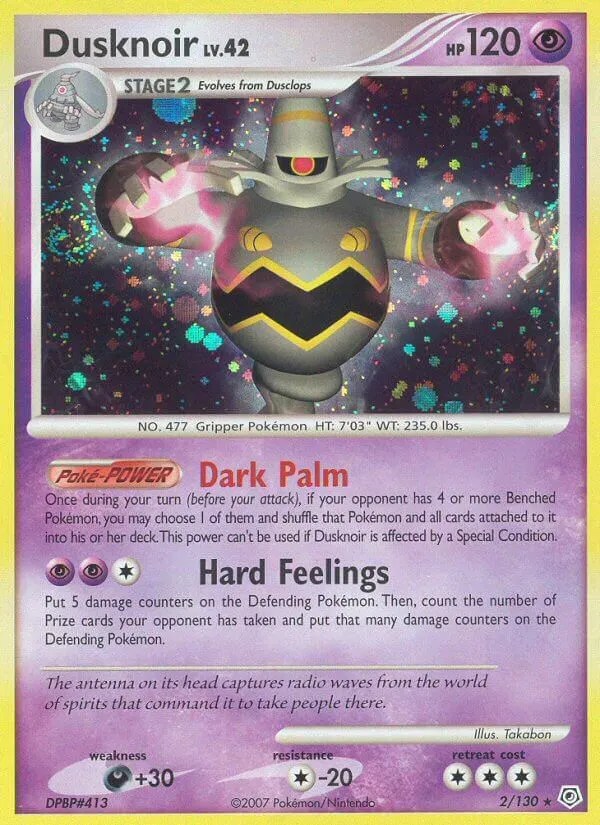
Dusknoir was popular in the 2010-era Garchomp decks – if you’re going for fast Speed Impact, keeping the opponent on the back foot is pretty important. Garchomp also makes really nice use of Cyclone Energy due to all the colorless energy in its attack costs, so it’s a lot easier in this deck to force the opponent’s active pokemon to the bench, THEN shuffle their big hitter back into their deck.

If not going for Dusknoir, Nidoqueen Rising Rivals is a solid option too! Maternal Comfort allows you to cycle between Garchomps and heal them, which makes them really hard to KO. Nidoqueen also has solid attacks, which shouldn’t be underestimated – Ruthless Tail especially can punish the opponent for maxing their bench, and you’re already using 4 Double Colorless Energy to take advantage of the attack cost.
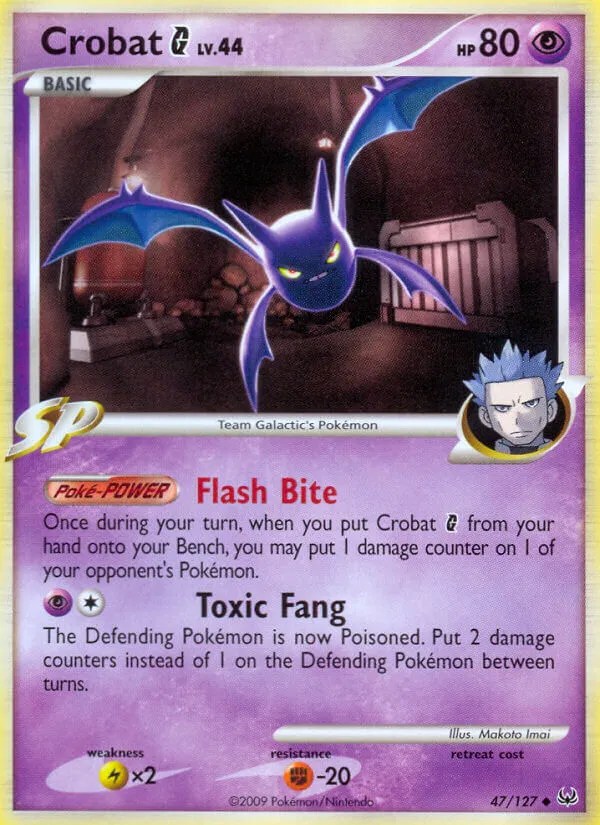
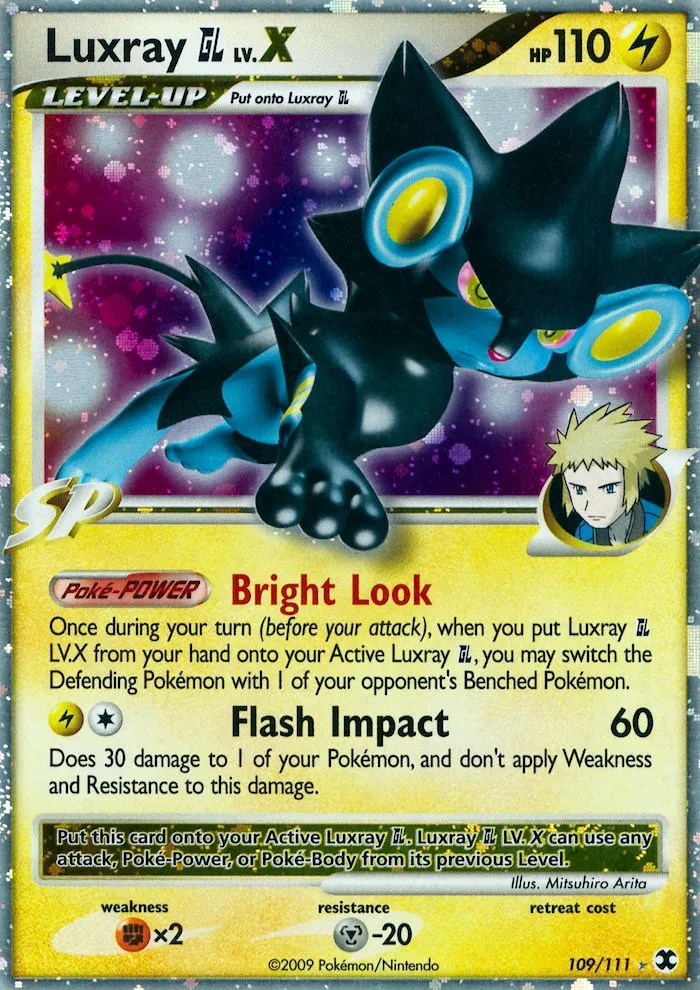
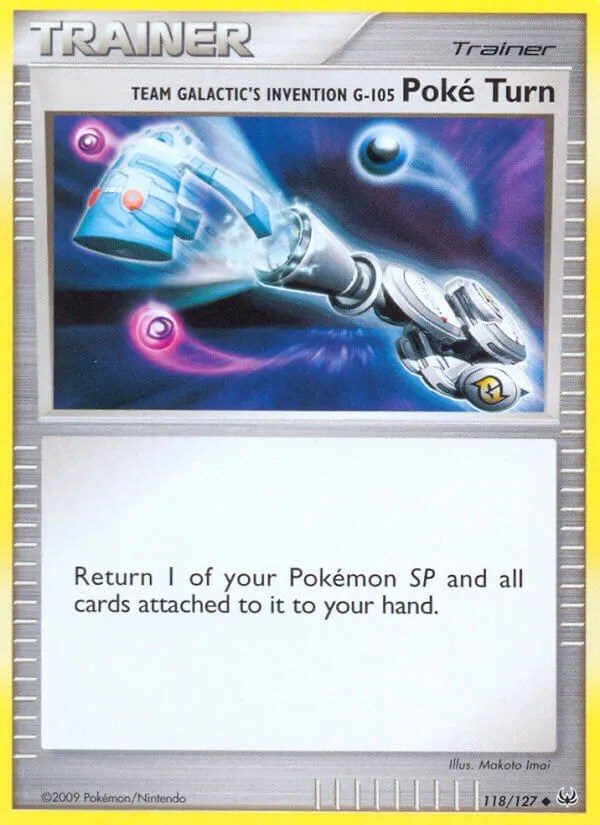
All 3 of these cards are useful no matter which route you end up going with the deck, but they are at their best in the aggressive versions. Luxray lets you not only hunt down pokemon with no energy on them, but you can specifically target pokemon like Claydol, or stage 1s that haven’t fully evolved yet, delaying your opponent’s set up. Crobat G adds up damage rather quickly. PokeTurn is useful with both of these pokemon, allowing you to re-use their abilities multiple times throughout the match. If you’re only playing Crobat G, you probably only need 1 or 2 copies of PokeTurn, but if you’re playing both, maximum copies might be more effective.
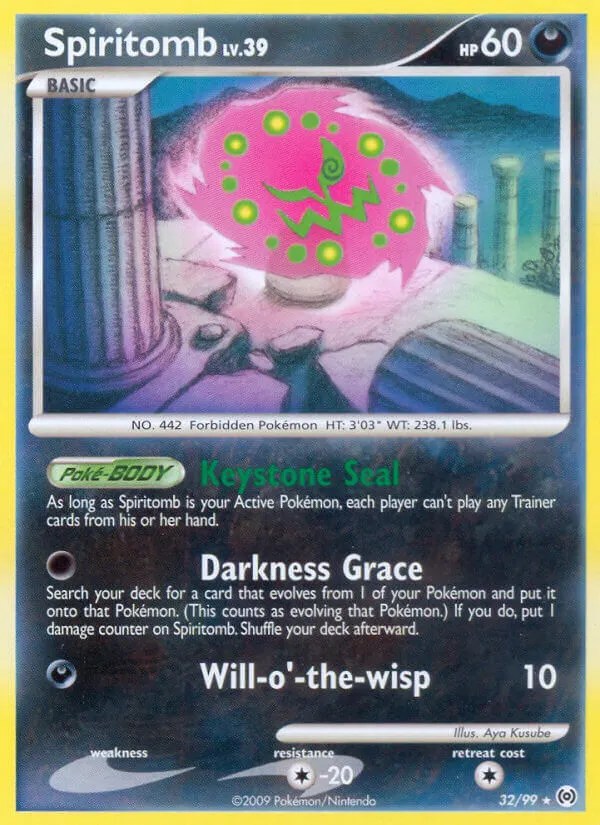
Spiritomb is a staple in a lot of evolution decks in this timeframe because of how it slows down aggressive decks in addition to furthering your set up. Garchomp can make use of this starter too, since it doesn’t typically require too many items to set up. Just make sure you play some Warp Energy in your deck with this pokemon, so you don’t get stuck in the active spot.

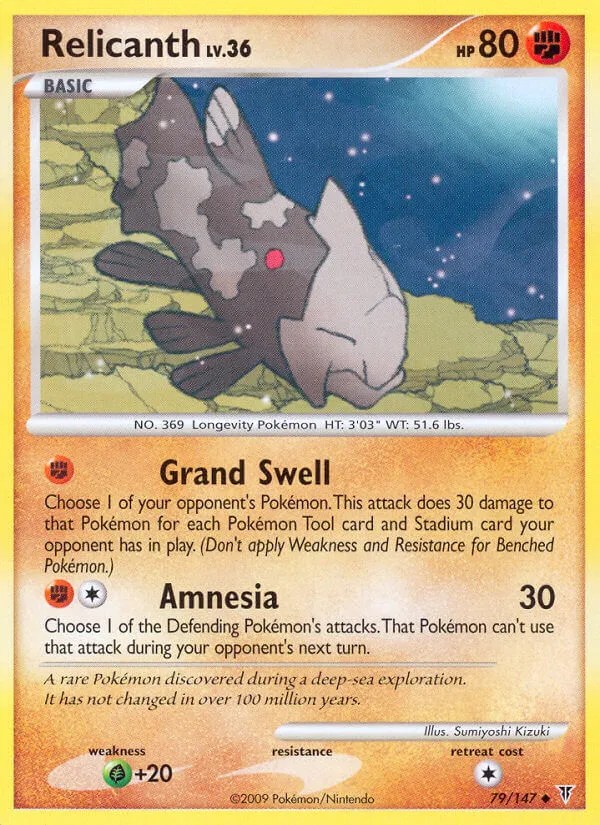
This pair of attackers can be pretty crucial depending on the matchup. As I mentioned before, Ambipom G is a pretty nice tech for Garchomp C Lv. X. Some SP decks in this era played Ambipom to try and combat opposing Garchomps, but as the season wore on, players realized they could play around Ambipom’s Snap Attack by manually attaching an extra energy (or using Bronzong G to move one over), so Dragonite FB became their tech of choice. This will almost never apply against Garchomp due to its poke-body – if it gets damaged by an attack, you get to bounce an extra energy back to your opponents hand, which means your opponent will need to have at least FOUR energy on their Garchomp in order to protect it. Relicanth can be good against a variety of decks, as there are a lot of Pokemon Tool and Stadium Cards floating around in this format. This will have the easiest time picking off opposing Luxray GL, but it can also be used to snipe pokemon like Claydol or Uxie – don’t forget that pokemon like Unown G and Unown Q count as Pokemon Tools when they are attached to your opponent’s pokemon!
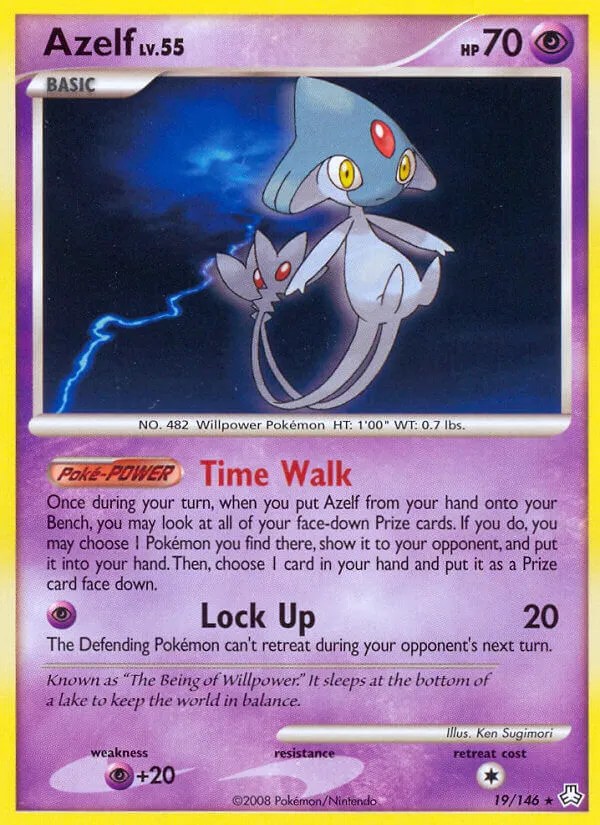
Really interesting case with Azelf – usually this pokemon is a shoo-in for most decks in this format, as Time Walk ensures nothing crucial is prized. Mark Garcia did include a copy in his deck. However, if your deck is more similar to Jay Hornung’s, there’s not a ton of really crucial 1-of pokemon that you NEED to have in play, so this is one of the rare cases where you can forego the Time Walking pixie.

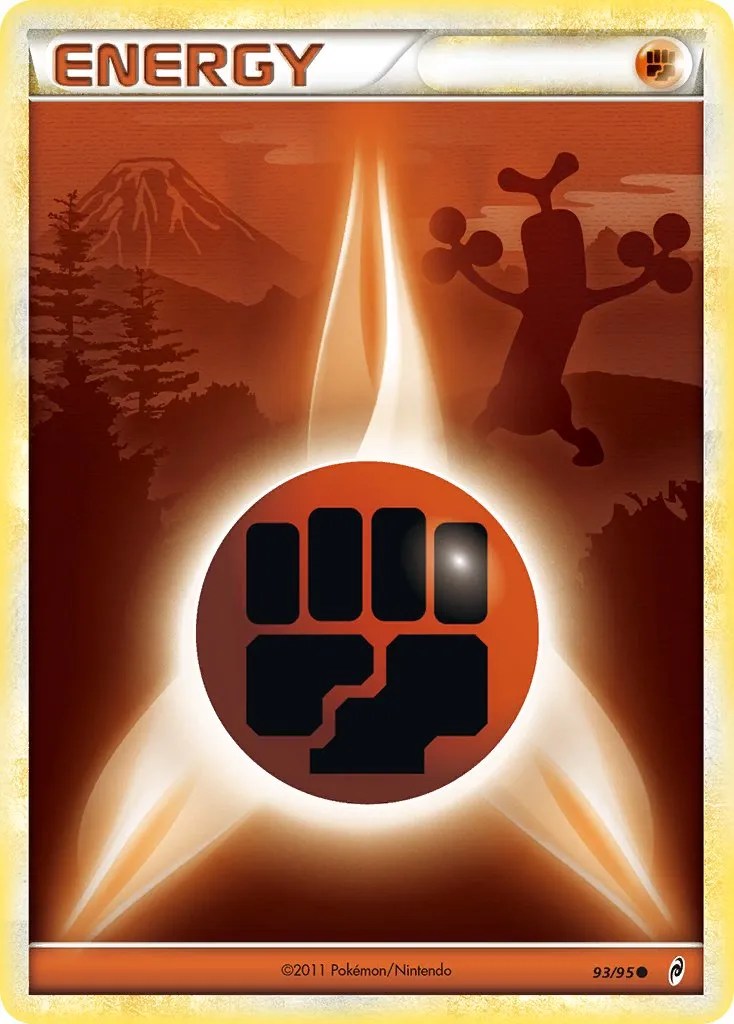



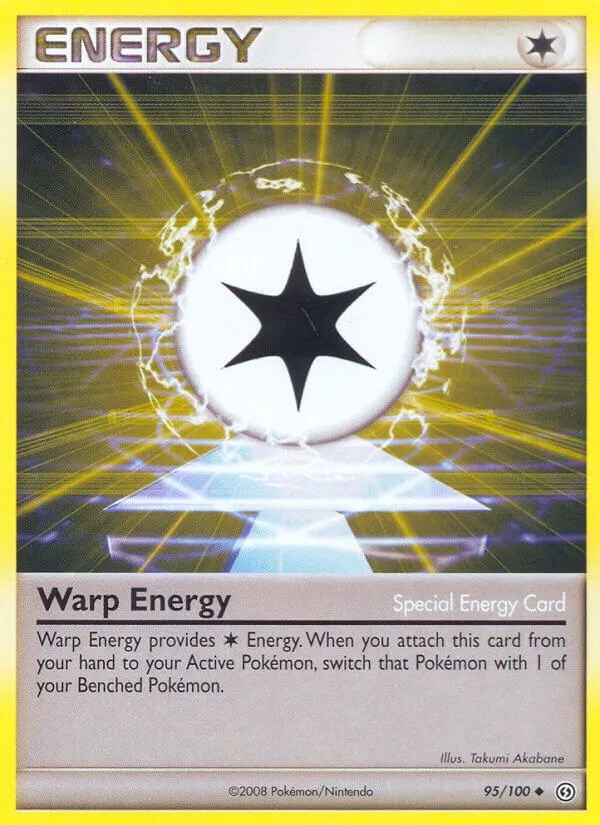
The world is Garchomp’s oyster when it comes to energy choices – all colorless in its attack cost means it can take full advantage of the (few) special energy that were legal in this timeframe. Double Colorless Energy and Call Energy are obvious choices – they up your consistency by a ton. Cyclone Energy pairs exceptionally well with Dusknoir, as you can potentially force a switch, and then shuffle your opponent’s main attacker back into their deck. Even without Dusknoir, though, an extra option to force a pokemon with less energy into the active spot is GREAT for taking KOs with Speed Impact. Warp Energy will be important if you are playing Spiritomb or Dusknoir – both have the potential to get stuck active to an opponent’s Chatot, but it can be useful even against pokemon like Blaziken FB. Psychic and Fighting Energy will depend on what tech attackers you have in your deck – Fighting Energy is included in Jay’s list because of Relicanth, while Psychic appears in Mark Garcia’s due to Azelf and Lock Up. Theoretically, you could use Lightning Energy to attack with Luxray GL Lv. X as well.

Speaking OF Chatot, Garchomp is a great deck to take advantage of Chatter – if you’re playing the extra outs to switch the opponent’s field around, you can potentially trap something in the active spot with Chatter, but even if you don’t plan on doing this ever, Mimic is just a great attack for setting up, and free retreat makes this a great pivot later in the game.
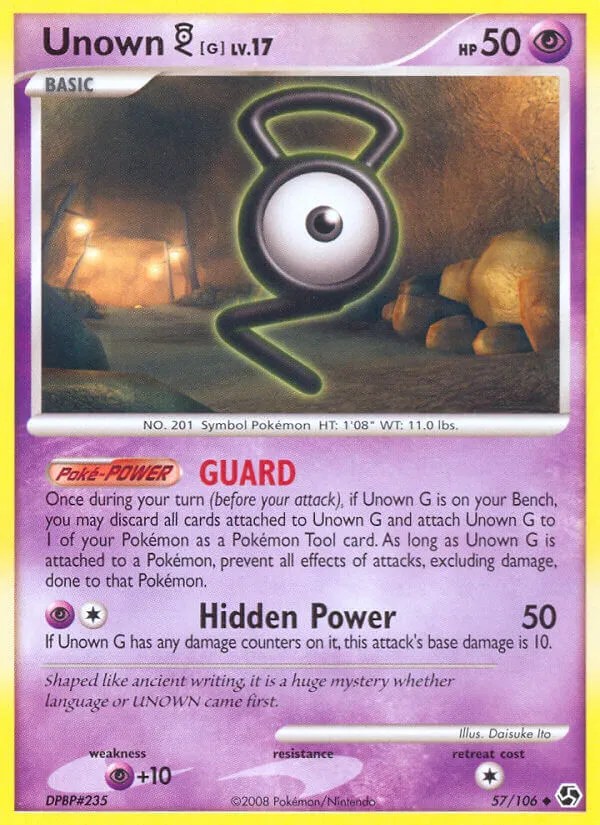
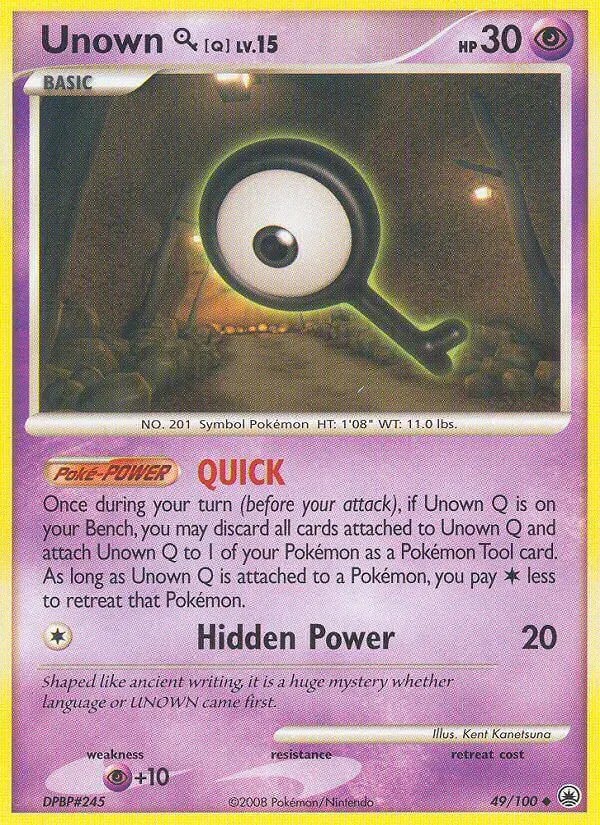
Both of these Unowns are good for different spots – Unown G will prtoect your Claydol and your Dusknoir from Gengar’s Shadow Room attack. They can also protect you from other random effects that do come up in this format, such as Blaziken FB’s forced switch, or Ambipom G’s ability to move energy around. Unown Q will be at its best with Spiritomb, as it gives you an searchable out for free retreat, but easily searchable ways to retreat are useful in a variety of scenarios.


Cyclone Energy has already been brought up, but I did want to re-highlight the fact that Garchomp has a LOT of options for forcing the opponent to switch around. Cyclone Energy will be good in every version, but Pokemon Reversal, Luxray GL Lv. X, and Warp Point can all be used as well depending on how aggressively you want to target down your opponent’s benched pokemon.
Considerations for DP-Block Format
While Flygon is generally the preferred Colorless attacker in the DP-Block format, I did at least want to highlight a few choices since the Garchomp line and all of its attackers are technically available to use in this Block-style format. The format shifts a bit as the format only uses the sets Diamond/Pearl Base-Platinum Arceus, so certain cards (like Jumpluff or Double Colorless Energy) aren’t legal.

We already talked a bit about Dusknoir, but I do want to re-highlight it for this format specifically. Since Flygon is much more popular in DP-block than it is in 2010 Worlds Format, having the ability to shuffle your opponent’s bench back in is pretty nice. It reduces Flygon’s Damage output, and unless they fill their bench past 3, they cannot OHKO your Garchomps.

As mentioned above, Double Colorless Energy was not printed until HeartGold & SoulSilver base set, so Upper Energy is the only card available that can potentially provide multiple colorless energy. It’s obviously not as strong as Double Colorless is, but you may as well include it since you won’t ALWAYS be leading in prize cards, and there’s not really any better special energy to choose from.

If you’ve read my articles before, you know I love throwing Ditto into just about any deck that can reasonably play it. If your Garchomp is already playing Psychic Energy, Ditto isn’t bad as an attacker against Gengar, but in DP-block specifically, having this guy to potentially swing into Flygon decks can be huge.
Conclusion
With the right list, Garchomp can compete with the best decks in the format. Its damage output as an aggressive attacker rivals the best in the format, and its ability to tank hits and heal is formidable as well. Since you have the potential to lean either direction, a lot of Garchomp’s matches are quite enjoyable and thought-provoking. If you haven’t given it a try, I would highly recommend it for your next retro gaming session! As always, thank you so much for reading! Hopefully I’ll catch you at the next article!
 PTCG Retro Library